A Bodycote interactive science feature

Thermal Processing and the Space Race

Travel through the hidden materials history that carried humanity from early rockets towards future pulse propulsion.

Engineering historyMaterials scienceEvidence update reviewed 11 September 2026
Enter the timeline
1969

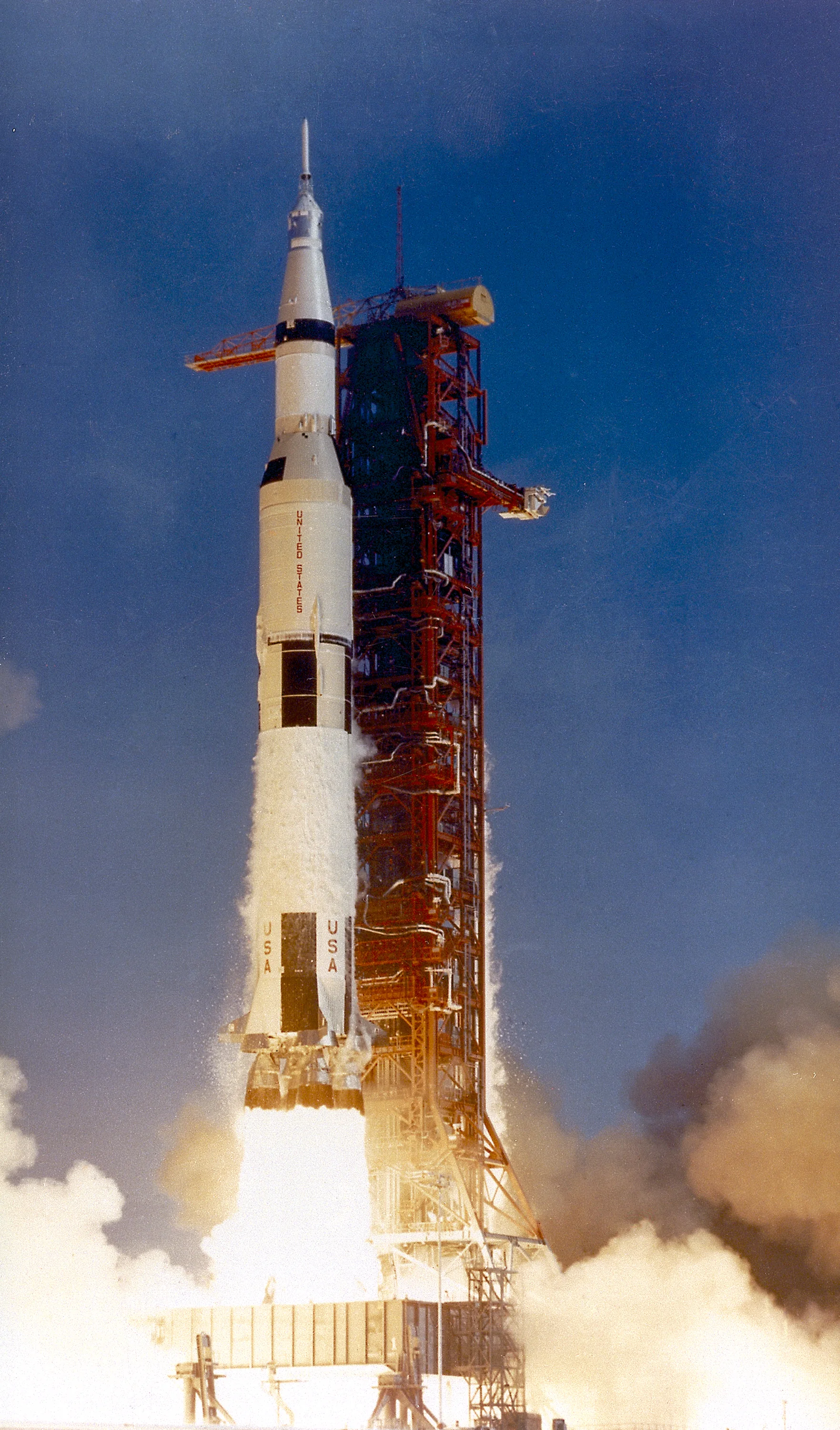
The visible vehicle rises through a story written in grains, phases, precipitates, interfaces and defects.

Apollo 11 launch image: NASA

Scroll to travel

Move through the heat-treatment history of spaceflight

Follow the materials and manufacturing history of spaceflight. Evidence labels distinguish documented thermal processing, related surface engineering and future possibilities.

Foundational discovery01 / 14
1906

Age hardening turns time into a materials tool

Alfred Wilm's discovery showed that aluminium alloys could become stronger after quenching as fine precipitates formed with time. Heat treatment could now engineer the structure hidden inside a component.

Aluminium alloys · quenching · natural ageing · precipitation hardening

Evidence statusLaboratory discovery · later industrialised

Image: Deutsches Museum archive · Junkers F 13 duralumin fuselage, 1919Artwork description: The corrugated duralumin fuselage of a Junkers F 13 aircraft, an early industrial use of age-hardened aluminium alloy
Pioneer 4 · flown upper stage02 / 14
1959

Annealed titanium helps Pioneer 4 escape Earth

To reduce the mass of Juno II's fourth stage, JPL replaced the stainless-steel rocket-motor case with annealed Ti-6Al-4V. The stage launched Pioneer 4, the first American spacecraft to escape Earth's gravity and enter heliocentric orbit.

Ti-6Al-4V · annealing · welded motor case · mass reduction

Evidence statusFlown hardware · Juno II AM-14 / Pioneer 4

Image: NASA/ABMA/JPL-Caltech · Pioneer 4 and Juno II fourth stage, 1959Artwork description: NASA and JPL engineers checking Pioneer 4 mounted on the white fourth-stage motor of the Juno II launch vehicle on 2 March 1959
Saturn I corrective action03 / 14
1964

A heat-treatment problem threatens an early Saturn booster

Stress-corrosion cracking was found in sleeves associated with Saturn I high-pressure lines. NASA replaced critical tubing assemblies with properly heat-treated material and recorded the S-I-5 stage as flight worthy after the corrective work.

High-pressure tubing · stress-corrosion control · corrected material condition

Evidence statusFlown programme · flight-hardware corrective action

Image: NASA/MSFC · Saturn I SA-5 launch, 1964Artwork description: The Saturn I Block II SA-5 vehicle lifting off from Launch Complex 37 on 29 January 1964
Apollo honeycomb evaluation report04 / 14
1969

Apollo's heat shield depended on heat before re-entry

Apollo-specification PH14-8Mo comparison panels were retort brazed at 1,685°F for 20 minutes, cooled, held at -145°F for eight hours, then aged at 1,065°F for 60 to 75 minutes. The 1969 study also tested flown Spacecraft 011 heat-shield specimens, whose original heat-treatment condition was unknown.

PH14-8Mo stainless steel · retort brazing · sub-zero treatment · ageing

Evidence statusDocumented panel processing · compared with flown specimens

Image: NASA · Apollo 11, August 1969 · contextual photographArtwork description: Contextual photograph of the Apollo 11 command module, not Spacecraft 011, being loaded into a Super Guppy aircraft in August 1969, with its heat-darkened aft heat shield visible underneath
Shuttle SRM development05 / 14
1978

Heat treatment is scaled to a 146-inch booster case

Space Shuttle solid-rocket motor steel-case components were successfully static tested. Their manufacture linked every steel heat, forging and heat-treatment run so that fracture-toughness evidence remained traceable at full booster scale.

Large steel forgings · production heat-treatment control · fracture toughness

Evidence statusSuccessfully static-tested development hardware

Image: NASA/MSFC · Shuttle SRB Qualification Motor 1, 1979 · development contextArtwork description: The aft end of the Shuttle solid rocket booster's Qualification Motor 1 being prepared for a static firing in Utah
Reusable main-engine production06 / 14
Shuttle era

The 1,080-tube nozzle is joined in the furnace

The Space Shuttle Main Engine nozzle used 1,080 tapered tubes, manifolds and a structural jacket with almost four miles of braze joints. Furnace cycles joined the assembly, while later process work targeted local void repair without damaging the parent materials.

SSME nozzle · conical coolant tubes · furnace brazing · braze-quality control

Evidence statusFlight-system production and repair-process record

Image: NASA/KSC · Block II Space Shuttle Main Engine, 2001Artwork description: A complete Block II Space Shuttle Main Engine in the processing facility, viewed from the wide end of its regeneratively cooled nozzle
Ariane 5 production07 / 14
1998

Quenching and tempering strengthen Europe's giant booster cases

Ariane 5 solid-booster cylinders were cold formed from special steel, taking the wall from 40 mm to 8 mm. ESA described a precise 'tempering/quenching treatment' that produced a breaking strength of 1,500 N/mm².

Special steel · flow forming · ESA tempering/quenching treatment · 1,500 N/mm²

Evidence statusDocumented production route

Image: NASA/Bill Ingalls · Webb launch, 2021 · production context · public domainArtwork description: An Ariane 5 launching the James Webb Space Telescope from Europe's Spaceport in December 2021, illustrating the later programme rather than the 1998 production record
STS-91 · first flight08 / 14
1998

A new treatment route makes the Shuttle tank lighter

Aluminium-lithium 2195 was solution treated and quenched to T0, stretch formed and shaped to T3, then finally aged to T8. The resulting Super Lightweight External Tank first flew on STS-91 in June 1998.

Al-Li 2195 · solution treatment · quenching · stretch forming · T8 ageing

Evidence statusFlown · first used on STS-91

Image: NASA/KSC · first Super Lightweight External Tank, 1998Artwork description: The first Shuttle Super Lightweight External Tank travelling by barge from Michoud toward Kennedy Space Center before STS-91
2195 treatment development09 / 14
2002

A revised ageing cycle rescues rejected Shuttle tank material

NASA's principal memorandum specifies 270°F for 20 hours followed by 280°F for 42 hours. The two-step age improved cryogenic toughness, stress-corrosion resistance and ductility while preserving yield strength; five rejected lots passed simulated service testing.

Al-Li 2195 · two-step ageing · T1 precipitate control · cryogenic toughness

Evidence statusProduction-applicable · simulated service tested

Image: NASA/MSFC · Michoud tank assembly, 1977 · manufacturing contextArtwork description: Space Shuttle external-tank sections being assembled at Michoud in 1977, providing manufacturing context rather than depicting the 2002 aluminium-lithium ageing study
Mars Exploration Rovers · flight mechanisms10 / 14
2003

A dry-film coating releases the rovers' eyes

Spirit and Opportunity's Pancam Mast Assembly launch locks used molybdenum-disulfide dry-film lubricant where pin-puller pins slid inside spherical-bearing bores. The mechanisms were designed for ground testing, hard-vacuum transit, dusty Mars operation and temperatures down to -70°C.

Pancam mast · launch-lock pin-pullers · MoS₂ dry-film lubricant

Evidence statusTwo flight units · flown on Spirit and Opportunity

Image: NASA/JPL · Opportunity rover and Pancam Mast Assembly, 2002Artwork description: NASA's Opportunity rover during assembly at JPL, with the tall white Pancam Mast Assembly rising above its equipment deck
James Webb Space Telescope · flight mirrors11 / 14
2004–21

Webb's golden mirrors begin as HIP-consolidated powder

JWST's mirror blanks were made from O30 beryllium powder by hot isostatic pressing. More than 92% of each blank was removed to form a lightweight honeycomb before cryopolishing, gold vacuum deposition and a protective SiOx overcoat.

O30 beryllium · HIP · cryopolishing · gold deposition · SiOx overcoat

Evidence statusFlight mirrors · launched 2021 · operating in space

Image: NASA/Chris Gunn · Webb primary mirror in the clean roomArtwork description: The assembled gold-coated primary mirror of the James Webb Space Telescope standing in a NASA clean room above technicians in protective clothing
NASA HR-1 nozzle development12 / 14
2021

Printing creates the shape. Heat treatment creates the material.

LP-DED NASA HR-1 nozzle hardware received stress relief, homogenisation, solution annealing and a selected two-stage age. NASA used the route to control segregation and eta phase while improving ductility and strain hardening before hot-fire testing.

NASA HR-1 · stress relief · homogenisation · solution annealing · two-stage ageing

Evidence statusGround hot-fire-tested propulsion hardware

Image: NASA · HR-1 nozzle hot-fire · later RAMPT programme workArtwork description: A NASA HR-1 alloy nozzle firing during a hot-fire test of a 2,000-pound-force coupled thrust chamber assembly at Marshall Space Flight Center
Hydrogen-environment characterisation13 / 14
2026

Heat treatment confronts the hydrogen problem

NASA's 2026 study characterises a route already documented in 2023: argon quenches after homogenisation and solution annealing, followed by two-step ageing. The treatment controls eta precipitation and balances ductility and low-cycle fatigue performance in hydrogen, without making the alloy immune to damage.

LP-DED NASA HR-1 · argon quenching · controlled precipitation · low-cycle fatigue

Evidence statusPublished material characterisation · propulsion-hardware development

Image: NASA · NASA HR-1 nozzle at left, JBK-75 liner at right · hardware contextArtwork description: Two large additively manufactured rocket nozzle liners: a 65-percent-scale RS-25 integral-channel nozzle made from NASA HR-1 at left and a full-scale solid JBK-75 liner at right
Ground test · historical concept · concept study14 / 14
Next

Future propulsion widens the heat-treatment challenge

Rotating detonation engines are ground tested; nuclear pulse propulsion has a detailed historical record; pulsed fusion remains a concept study. Future thermal-processing routes may need to control microstructure, defects, toughness and fatigue under harsher cyclic loads. That final link is a labelled metallurgical inference.

Cyclic thermal loading · fatigue-resistant microstructures · defect control · radiation tolerance

Evidence statusCited propulsion challenge · labelled metallurgical inference

Images: NASA/MSFC · US Air Force Research Laboratory · Lawrence Livermore National LaboratoryArtwork description: Three real source images: a NASA rotating detonation engine hot-fire test, a 1962 Project Orion nuclear-pulse spacecraft model and the National Ignition Facility target chamber

The timeline distinguishes documented thermal processing from related surface engineering and labelled future inference. The rover lubricant source does not establish a thermal-processing route; contextual photographs are identified separately.

The corrected premise

Not every hot component was heat treated. Not every thermal process is heat treatment.

Spaceflight became practical when engineers learned to control not only the shape of a metal part, but also the structure hidden inside it. Heat treatment was one member of a larger manufacturing system that included alloy development, forming, joining, HIP, surface engineering, inspection and proof testing. Operational heat, thermal control and atmospheric-entry protection are separate engineering stories. They meet metallurgy, but they are not interchangeable with manufacturing heat treatment.

Six ideas, separated

The word “thermal” hides different engineering problems

A furnace cycle changes material before launch. Combustion heat, radiators and entry shields solve different operational problems. Confusing them produces a persuasive but false story.

01

Heat treatment during manufacture

Solution treatment, quenching and ageing alter a component's microstructure before it flies.

Inside this story
02

Related thermal processing

Brazing, HIP, diffusion treatments and some coating routes use heat but are not all heat treatment in the narrow sense.

Inside this story
03

Operational heat

Combustion gas and friction heat a component in service. That heating is a load, not evidence of prior heat treatment.

A separate system
04

Spacecraft thermal control

Radiators, insulation, heaters and heat pipes manage temperature during a mission.

A separate system
05

Atmospheric-entry protection

Ablators and reusable tiles protect a vehicle from aerodynamic heating.

A separate system
06

Microgravity materials research

Small samples are melted or solidified to study fundamental materials behaviour, not to run an orbital production heat-treatment line.

A separate system

01 · The metal behind the mission

A spacecraft is a map of incompatible demands

Select a system. Each wants a different balance of mass, toughness, temperature capability, conductivity, fatigue life, wear resistance and inspectability.

Cutaway launch vehicleA sectional drawing showing tanks, structural rings, engines and nozzle. Select the overlaid controls to inspect systems.LOXFUELENGINE

Selected system

Propellant tanks

Conditions
Cryogenic temperature, pressure, welds and launch vibration
Typical material families
Heat-treatable aluminium and aluminium-lithium families; selected stainless steels
Properties required
Low mass, fracture toughness, weld integrity and cryogenic performance
Relevant processing
Solution treatment and ageing where specified, forming, welding and inspection
If it fails
Leakage, rupture or loss of propellant

Evidence boundary: Typical practice; Saturn V and Shuttle examples are separately verified

02 · Before the space age

The rocket inherited an aviation revolution

Early launch vehicles inherited age-hardened aluminium, gas-turbine superalloys, vacuum melting, controlled atmospheres, better furnaces and a culture of process records.

Age hardening showed that properties could change after quenching. Aviation advanced high-temperature alloys, forging, joining, coatings and inspection. Rocket engineering applied those methods to pressure vessels, cryogenic systems and combustion hardware.

Early rocket development included military programmes in Nazi Germany. Production of the V-2 used forced labour from concentration camp prisoners. NASA: historical account

NIST: precipitation hardening   ASM: superalloy history

03 · A controlled journey through temperature

Heat treatment is a sequence, not a glow

Temperature, time, atmosphere, heating and cooling rates, and prior history work together. Change the route and the internal structure changes with it.

Choose a route

Illustrative route only. The exact schedule depends on alloy, product form and specification.

The vertical scale is normalised, not a temperature specification. It shows sequence and purpose without inventing a flight process sheet.

Process time →Relative temperature
Solution treatmentDissolve selected alloying elements into a solid solution
QuenchRetain a supersaturated structure by rapid cooling
AgeForm a controlled dispersion of strengthening precipitates
InspectConfirm hardness, conductivity, dimensions and defects as required

Drag the boundary

Microstructure turns processing into properties

Fine precipitates can obstruct dislocation motion and raise strength. Coarse or poorly placed phases can reduce ductility or accelerate cracking. Grain size and grain-boundary condition alter fatigue, creep and fracture behaviour.

Conceptual diagram. Real grain size, phases and precipitate distributions depend on alloy, product form and treatment history.

04 · Apollo and the Moon

The hidden metallurgy of a Moon mission

Apollo's manufacturing history includes heat-treated forgings, brazed honeycomb, welded tubing, inspected pressure vessels and hard-won process limits.

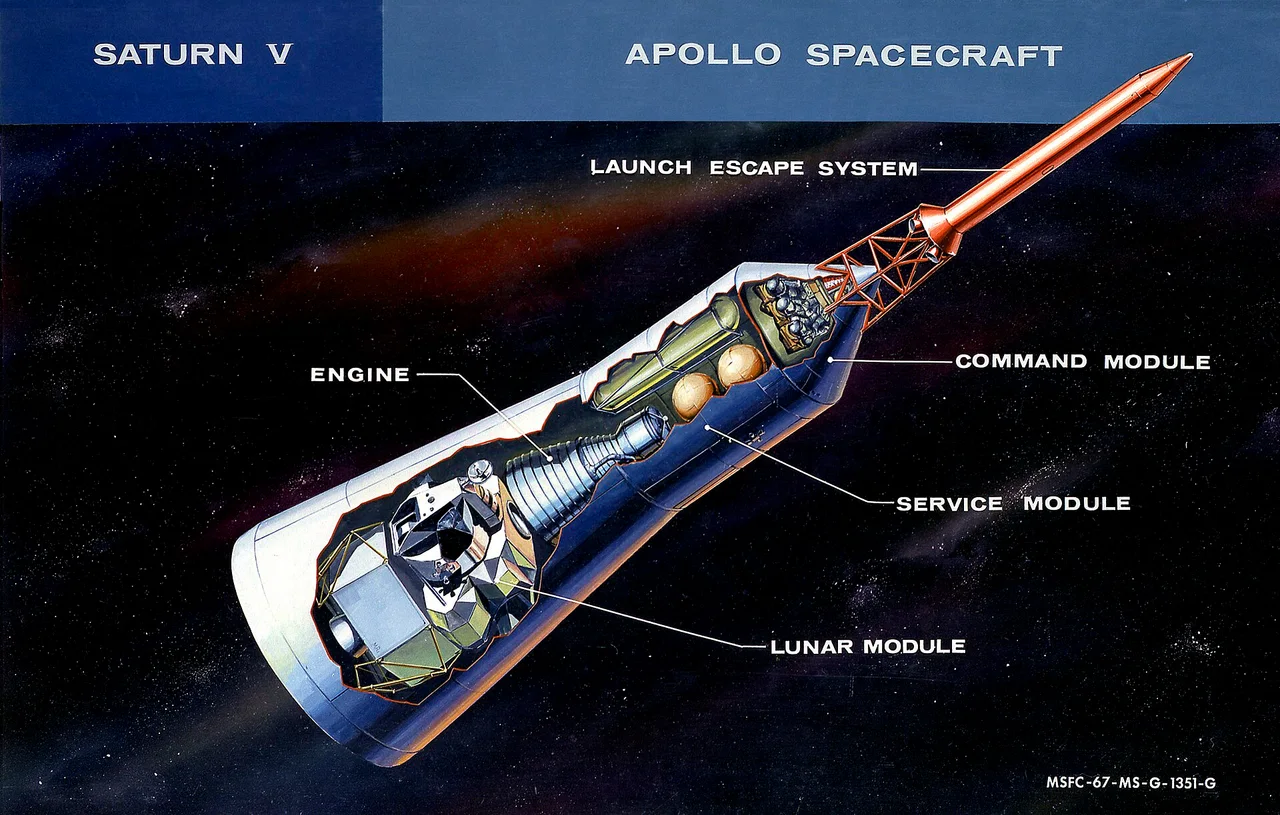
NASA cutaway illustration of the Apollo spacecraft inside the Saturn V adapter, showing the lunar module, service module, command module and launch escape system.
NASA/MSFC Apollo spacecraft cutaway, circa 1967. View source

Materials map

Launch vehicle tanks

Verified mission-era process
Material
Heat-treatable aluminium structures
Manufacturing reading
Saturn V production used age forming and distortion-control research.

How to read the evidence

VerifiedMission or programme evidence
TypicalAerospace use not tied to this mission
InferenceEducated inference shown to expose uncertainty

05 · Making spacecraft reusable

A second flight changes the question

The Space Shuttle Main Engine faced high-pressure hydrogen, cryogenic propellants, start-up and shutdown transients, braze joints and turbomachinery fatigue. Reuse turned one firing into the beginning of a life record.

S10   S14

Load history

Many starts, flights and shutdowns

Damage accumulation becomes part of design and operations.

Thermal cycles

Repeated cryogenic-to-hot transitions

Low-cycle fatigue and microcrack growth become life drivers.

Inspection

Between missions

The part must expose detectable damage before it becomes critical.

Design pressure

Life, turnaround and repair

A heavier but inspectable part may outperform a lighter disposable one.

1,080 conical tubes

The Shuttle main-engine nozzle's tubes, manifolds and structural jacket created almost four miles of braze joints.

Repair had to restore a local joint without damaging the parent material or shortening service life. S11

06 · Satellites, probes and stations

Spaceflight continues after the engine stops

A reaction wheel may turn billions of times while a deployment hinge waits years for one attempt. Thermal processing matters alongside lubrication, cleanliness, radiation design and inspection.

Mechanisms

Bearings, gears and robotic joints

Hardness, dimensional stability and surface condition control fatigue and wear. Vacuum changes lubrication and removes routine maintenance.

Heat treatment plus tribology
Structures

Frames, antennas and pressure systems

Thermal cycling creates expansion mismatch. Atomic oxygen and radiation introduce further material constraints.

A system problem
Long life

Deep-space probes

Alignment, wear resistance and redundant mechanisms matter when repair is impossible.

Reliability over decades
Two flight systems, two material routes

Spirit and Opportunity's Pancam mast launch locks used molybdenum-disulfide dry-film lubricant on pin-pullers sliding inside spherical-bearing bores. The engineering record identifies two flight units built to the same specification. S61   S62

JWST's flight mirror blanks began as O30 beryllium powder consolidated by hot isostatic pressing. They were lightweighted, cryopolished, gold coated by vacuum deposition and protected with a SiOx overcoat before flight acceptance testing. S60

A careful orbital footnote

Metals really are melted in space

ISS research furnaces and electromagnetic levitators melt small samples to isolate gravity-driven convection, sedimentation and container effects.

This reveals how structures form in microgravity. It is not industrial-scale heat treatment of flight hardware.

ESA electromagnetic levitator   NASA microgravity research guide

07 · The additive-manufacturing era

Printing is often the beginning of the route

Internal channels, part consolidation and fewer welds bring advantages. Residual stress, rough passages, anisotropy, porosity and qualification follow the part out of the machine.

Powder or wire: Chemistry, cleanliness, size distribution and reuse history shape what the process can deliver.

Ground tested, not assumed flown

NASA's LLAMA, GRCop and rotating-detonation programmes document additive routes, post-processing and hot-fire testing. In 2021, LP-DED HR-1 nozzle hardware received stress relief, homogenisation, solution annealing and a two-stage age before hot-fire testing.

S19   S21   S22   S56

08 · The hydrogen problem

The smallest atom can rewrite a large design

Liquid hydrogen brings cryogenic temperatures, while high-pressure gas can enter metals. Susceptibility depends on microstructure, strength, surface condition, stress, temperature, pressure and time.

Move the exposure

Hydrogen atoms can diffuse through a metal and collect at microstructural traps, highly stressed regions and crack tips. Susceptibility also depends on alloy, strength, temperature, pressure, surface condition and load history.

Relative crack riskRising
Visible atoms10

Conceptual visual only. It is not a predictive embrittlement model. No single heat treatment makes every alloy safe in hydrogen.

There is no universal anti-embrittlement cycle

Heat treatment changes microstructure and strength, but stronger can sometimes mean less tolerant of hydrogen-assisted cracking. NASA requires degradation to be addressed through material selection and process control. S25

NASA's 2026 HR-1 work documents argon quenches, controlled ageing and fatigue performance in high-pressure hydrogen. It remains development evidence, not a universal guarantee. S57

09 · Pulse propulsion

Three drives with almost nothing in common

One burns chemical propellant in detonations, one proposed nuclear explosions against a pusher plate, and one seeks directed exhaust from pulsed fusion. Their readiness is not equal.

Ground tested

Pulse and rotating detonation

Hardware
Annular chamber, injectors, integrated cooling and nozzle
Materials problem
Repeated detonation fronts, high local heat flux, thermal fatigue and cooling-channel integrity
Evidence
GRCop-42, GRX-810 and C-103 have been used in NASA ground-test hardware
Constraint
Pressure-gain benefits must survive real turbomachinery integration, cooling, operability and life requirements.

10 · Mission materials challenge

Build a materials plan. Then try to break it.

Choose a mission, defined material family and product form, processing route and verification campaign. Your architecture must clear five concept-review gates; technically incomplete routes can fail.

01 Mission02 Material03 Processing04 Verify

Just for fun. This is an evidence-led concept game, not a materials-selection or process-specification tool.Contact Bodycote's experts about a real challenge

Mission materials challenge

How to play the mission materials challenge

  1. 01
    Choose a mission architecture

    Select one of the six missions. Each has a different component brief, engineering allowance and set of critical requirements.

  2. 02
    Choose a material

    Select the material family and product form you think best suit the mission. Review its strengths, limitations and point cost before committing.

  3. 03
    Choose a processing route

    Select the thermal-processing route needed to establish the required final material condition. A suitable material can still fail if the processing route is incompatible or technically incomplete.

  4. 04
    Choose a verification campaign

    Select which critical risks the proposed campaign would investigate. The game requires coverage of at least two of the mission's four critical demands. A passing concept can therefore have partial verification; its result identifies the uncovered demands. Full game coverage is not physical qualification.

  5. 05
    Watch the engineering allowance

    Every choice uses points. Your combined material, processing and verification plan must remain within the allowance shown in the qualification console.

  6. 06
    Run qualification

    Once all three decisions have been made, select Run qualification. The game assesses the plan against five concept-review gates:

    • comparative mission fit;
    • material requirement bands;
    • processing logic;
    • engineering allowance;
    • verification coverage.
  7. 07
    Review the result

    A route may pass, fail or remain limited by a genuine current-technology gap. Read the result explanation to see which choices worked and where the proposed plan fell short.

The objective is not simply to choose the most advanced or expensive option. It is to assemble a coherent material, processing and verification plan for the particular mission.

Build viable plans and identify the missions that still need new technology.

Just for fun. The challenge is for educational entertainment only. Its scores are comparative editorial bands, not material data, design allowables, process specifications or engineering guidance. For a real materials challenge, contact Bodycote's experts.

CALLSIGN / ARES TRANSFER

Long life, radiation, repairability and heat rejection compete with launch mass.

Component brief: Long-life primary structure

Low massStrengthFatigueInspect
02 Choose the primary material family

11 · The next metallurgical frontier

A horizon is not a delivery date

The 25, 50 and 100-year labels organise questions, not breakthroughs. Readiness follows the strongest public evidence, from hot-fire tests to physically plausible speculation.

Evidence ladder

01Operational
02Flown experimentally
03Ground tested
04Laboratory demonstrated
05Active engineering development
06Detailed concept study
07Preliminary concept
08Speculative but physically plausible
09Unsupported or fictional
NASA HR-1 for hydrogen-fuelled hardwareActive engineering development · 25 years

A complete heat-treatment route and hydrogen-environment characterisation exist; application-specific qualification is still required. S57

NASA HR-2 hydrogen-resistant alloyLaboratory demonstrated · 25 years

Mechanical and hydrogen testing exists, but no flight use is claimed in this experience. S48

GRX-810 ODS superalloyGround tested · 25 years

Additively made injectors and channel-cooled nozzles were hot-fire tested; turbine-related examples demonstrate fabrication. S24

Functionally graded copper-nickel chambersActive engineering development · 25 years

NASA-funded work targets interface science, process control and property validation. S33

AM in-process monitoring for acceptanceActive engineering development · 25 years

NIST identifies measurement and qualification gaps that still limit critical-part acceptance. S32

Radiation-tolerant high-entropy alloysLaboratory demonstrated · 50 years

Irradiation research is credible, but composition stability and engineering databases remain incomplete. S34

Metal-matrix and refractory compositesLaboratory demonstrated · 50 years

Promising for temperature and radiation, with joining, oxidation and inspectability constraints. S31

Metal repair and recycling in spaceActive engineering development · 50 years

NASA is developing servicing, recycling and manufacturing capabilities; routine metal repair is not operational. S35

Pulse-resistant fusion-facing structuresPreliminary concept · 100 years

Terrestrial experiments study repeated intense pulses, but no spacecraft material system is qualified. S31

Ten stories worth sharing

Small doors into a very large subject

01

The hidden metallurgy of Apollo

A mission map that separates proven hardware from typical practice and inference.

Open story
02

Why a printed rocket part still needs heat treatment

Seven stages from powder to qualification.

Open story
03

Three pulse drives, three different realities

Ground-tested chemistry, historical nuclear studies and preliminary fusion concepts.

Open story
04

Could metal survive thousands of nuclear pulses?

Why pusher erosion, fatigue, shock absorption and policy all matter.

Open story
05

The materials problems between Earth and Mars

Mass, radiation, repair and heat rejection refuse to optimise together.

Open story
06

Which material would you choose for a Mars spacecraft?

An adjustable challenge where no candidate wins every category.

Open story
07

A rocket gets hot. That does not mean it was heat treated

Six thermal ideas that are often confused, separated in one view.

Open story
08

The 1,080-tube nozzle

How furnace brazing tied the Space Shuttle Main Engine nozzle together.

Open story
09

Hydrogen changes the rules

The same alloy can behave differently when tiny hydrogen atoms reach traps and crack tips.

Open story
10

Metallurgy in orbit, carefully stated

The ISS melts research samples, not production-scale rocket hardware.

Open story

Searchable glossary

The vocabulary inside the metal

Plain-language definitions for the terms used throughout this experience.

Age hardening
Strengthening an alloy by allowing fine precipitates to form with time, either at room temperature or elevated temperature.
Annealing
Heating and cooling intended to soften a material, relieve stress or alter its microstructure.
Brazing
Joining parts with a molten filler metal while the parent materials remain solid.
Cryogenic
Relating to very low temperatures, such as those used to store liquid oxygen or liquid hydrogen.
Creep
Time-dependent deformation under load, usually important at elevated temperature.
Directed-energy deposition
An additive process that feeds powder or wire into a focused energy source as material is deposited.
Embrittlement
Loss of ductility or toughness that makes cracking more likely.
Fatigue
Damage and crack growth caused by repeated or fluctuating loads.
HIP
Hot isostatic pressing: heat and high gas pressure applied from all directions, often to reduce internal porosity or bond materials.
Hydrogen-assisted cracking
Crack initiation or growth made easier by hydrogen interacting with stress and material microstructure.
Laser powder-bed fusion
An additive process in which a laser selectively melts regions of a metal powder layer.
Microstructure
The grains, phases, precipitates and defects inside a material that help determine its properties.
Precipitate
A small second phase that forms within a material and may strengthen or weaken it depending on type, size and distribution.
Quenching
Rapid cooling from an elevated temperature to retain a desired non-equilibrium structure.
Solution treatment
Heating and holding an alloy so selected constituents dissolve into the matrix, followed by sufficiently rapid cooling to retain them in solid solution.
Stress relief
A thermal treatment intended to reduce residual stress without necessarily producing the final service microstructure.
Surface engineering
Processes that modify a component's surface to improve wear, friction, corrosion or thermal behaviour.
Thermal fatigue
Fatigue driven by repeated temperature changes and the resulting expansion, contraction and stress.

23 audited evidence chains

Where the manufacturing evidence is strong enough to name

Each row names the strongest status established by its cited source, keeping flown hardware, tests and material studies distinct.

Twenty-three verified spaceflight programme and hardware examples
#ProgrammeComponentThermal-processing connectionEvidence statusSource
1Juno II / Pioneer 4Fourth-stage welded rocket-motor caseAnnealed Ti-6Al-4V substituted for Type 410 stainless steel to reduce stage massFlown; launched Pioneer 4 on 3 March 1959S63 · S64
2Saturn I / SA-5Critical high-pressure tubing assembliesReplacement with properly heat-treated material after stress-corrosion crackingFlown programme; flight-hardware corrective actionS51
3Saturn VCylindrical tank and double-curvature gore segmentsAge forming and heat-treatment hardeningFlown programmeS03
4Saturn VAlloy 718 bellows and gimbal structuresThermal-treatment optimisation against weld microfissuringProgramme development; exact flight item not provenS04
5Saturn S-II and Apollo304L pressurised tubingAutomatically controlled in-place fusion weldingApproved production methodS05
6ApolloCryogenic oxygen storage pressure vesselsHeat-treated Inconel 718 forgings and electron-beam weldingFlownS06
7Apollo honeycomb evaluationPH14-8Mo comparison panels and Spacecraft 011 heat-shield specimensRetort brazing, sub-zero treatment and ageing documented for comparison panels; flown specimens' original treatment unknownPanel-process record; comparison with flown structureS07
8Apollo lunar moduleDescent-stage fuel-to-helium heat exchangerInitial nickel-chromium braze replaced by gold-alloy braze; water excluded from cryogenic-helium cold-flow tests after failureFlight-system developmentS08
9Space Shuttle Solid Rocket Motor146-inch steel-case componentsHeat-treatment control with run-by-run material traceabilitySuccessfully static-tested development hardwareS09
10Space Shuttle Main EngineTube-wall nozzleFurnace brazing of 1,080 conical tubes and local braze repair developmentFlight-system production and repair-process recordS10 · S11
11Space Shuttle Main EngineInconel 718 hydrogen bellowsCopper electrodeposition before forming and later heat treatmentDocumented development; flight use not established by this briefS12
12SSME alternate turbopumpPWA 1480 single-crystal turbine bladesHIP and alternate solution heat treatmentsDevelopment programme; not claimed as operational flightS41
13Ariane 5Solid-booster thin-wall steel casesFlow forming followed by ESA's documented tempering/quenching treatmentDocumented production routeS15
14Ariane 6Vulcain 2.1 regeneratively cooled nozzleLaser welding of two sheets to create cooling channelsFlown; joining route verifiedS16 · S47
15Space Shuttle Super Lightweight External TankAl-Li 2195 barrels and intertank thrust panelsSolution treatment and quenching to T0, forming to T3, then final ageing to T8Flown; first used on STS-91S52 · S53
16Super Lightweight External Tank programmeAl-Cu-Li 2195 material lotsTwo-step artificial age: 270°F for 20 hours, then 280°F for 42 hoursProduction-applicable; simulated service testedS54 · S55
17NASA LLAMAGRCop-42 thrust chamber assembliesPowder-bed fusion, HIP and electron-beam welded manifoldsGround hot-fire testedS19
18NASA HR-1 nozzle developmentLP-DED channel-wall nozzle hardwareStress relief, homogenisation, solution annealing and two-stage ageingGround hot-fire-tested propulsion hardwareS56
19NASA HR-1 hydrogen developmentLP-DED material and nozzle-development hardwareArgon-quenched homogenisation and solution annealing followed by two-step ageing, documented in 2023 and characterised in 2026Published material characterisation; propulsion-hardware developmentS20 · S57
20NASA rotating detonation researchGRCop-42, GRX-810 and C-103 thrust hardwareAdditive manufacture with alloy-specific post-processingGround hot-fire testedS21
21NASA GRX-810 developmentPentad injectors and channel-cooled nozzles; turbine-related fabrication examplesAdditive manufacture and material development; hot-fire testing of injectors and nozzlesInjectors/nozzles ground hot-fire tested; turbine examples fabricatedS24
22James Webb Space TelescopePrimary mirror blanks and flight mirror segmentsHIP-consolidated O30 beryllium, cryopolishing, gold vacuum deposition and SiOx overcoatFlown and operational in spaceS60
23Mars Exploration Rovers Spirit and OpportunityPancam Mast Assembly launch-lock pin-pullersMoS₂ dry-film lubricant on sliding pins within spherical-bearing boresTwo flight units; flown on Spirit and OpportunityS61 · S62

Evidence and source quality

The claim is only as strong as the source

Programme reports, investigations, standards and agency archives carry the named history. Handbooks support general metallurgy. Public Bodycote pages define modern process categories.

Source-quality report

Strongest evidence: Manufacturing reports, programme papers and peer-reviewed records explicitly name components, materials and processes.

Moderate evidence: Mission and technical sources can verify different facts. They are not silently merged into one process claim.

Known geographic bias: Publicly searchable English-language component records are much deeper for US programmes than for Soviet, Russian, Chinese and Indian programmes. The timeline follows documented processing and related surface engineering, with future possibilities separately labelled. The wider source register retains international context with its limitations visible.

Image policy: The timeline uses registered archival and agency photography selected to match each stage. Original diagrams remain in explanatory interactions elsewhere on the page. Every external asset is listed in an image register.

Open timeline source registerOpen timeline artwork registerOpen full source register

Claims withheld or narrowed

  • No public evidence reviewed confirms that Bodycote processed a named mission, rocket or spacecraft component.
  • No exact Apollo F-1 or J-2 alloy-to-heat-treatment schedule is asserted without a component manufacturing record.
  • The current source set does not support naming a specific alloy and heat-treatment route for Sputnik, Vostok, Soyuz, the Apollo lunar rover, Hayabusa, Chandrayaan, Chang'e or Perseverance flight components. They are not main timeline evidence.
  • ISS Inconel 718 battery pressure vessels are verified, but their exact production heat-treatment schedule is not established. ISS melting and solidification experiments are separate research activity, not routine processing of flight hardware.
  • Ariane 6 aluminium-lithium tank construction is verified, but the exact temper schedule is not published in the cited ESA explainer.
  • PWA 1480 processing is tied to the SSME alternate-turbopump development programme, not claimed here as baseline operational Shuttle hardware.
  • No pulsed fusion propulsion system has flown or been integrated as an operational spacecraft engine.
  • No nuclear pulse propulsion system is approved, operational or close to deployment.
S01

Precipitation hardening of metal alloys

Wilm discovered age hardening in aluminium during 1903 to 1911; NBS work in 1919 established the theoretical basis for precipitation hardening.

National Institute of Standards and Technology · 2001

Authoritative institutional history · High confidence

Open source
S02

Polycrystalline cast superalloys

Nickel superalloys grew from piston-engine turbocharger and gas-turbine development, with precipitation-strengthened systems emerging before and during the Second World War.

ASM International · 1990

Authoritative materials handbook · High confidence

Open source
S03

Manufacturing research in support of Saturn V

Saturn V production used age-forming and heat-treatment hardening of aluminium tank and gore segments to control shape and weld distortion.

NASA Marshall Space Flight Center · 1965

Primary programme technical report · High confidence

Open source
S04

Establishment of an optimum heat treatment of the 718 alloy for use in bellows and gimbal structures

The Saturn V programme investigated how Alloy 718 thermal history affected weld microfissuring in bellows and gimbal structures.

NASA · 1966

Primary contractor report · Medium confidence

Open source
S05

Special tooling for joining tubing in place

Automatically controlled fusion welding was approved for 304L tubing in Saturn S-II and Apollo pressurised systems.

NASA · 1966

Primary programme conference paper · High confidence

Open source
S06

Report of Apollo 13 Review Board, appendix B

Apollo cryogenic oxygen tank pressure vessels used rough-machined, heat-treated Inconel 718 forgings and electron-beam welded hemispheres.

NASA · 1970

Primary mission investigation · High confidence

Open source
S07

PH14-8Mo stainless steel honeycomb core shear strength at elevated temperatures

The report compares PH14-8Mo stainless-steel honeycomb specimens from Apollo Spacecraft 011 with newly fabricated panels made to an Apollo brazing and precipitation-ageing process.

NASA · 1969

Primary NASA contractor report · High confidence

Open source
S08

Apollo experience report: Descent propulsion system

An early lunar-module fuel-to-helium heat exchanger used a nickel-chromium braze; a ground-test failure led to a gold-alloy braze and revised cold-flow testing.

NASA · 1973

Primary programme experience report · High confidence

Open source
S09

Space Shuttle SRM metal case component fabrication

Space Shuttle solid-rocket motor steel-case production controlled data heat by heat, forging by forging and heat-treatment run by run.

NASA / Thiokol · 1978

Primary programme conference paper · High confidence

Open source
S10

Materials and processes for Space Shuttle engines

The reusable Space Shuttle Main Engine used more than 50 alloys and relied extensively on welding, brazing and electroforming.

NASA / Rocketdyne · 1975

Primary programme technical paper · High confidence

Open source
S11

Laser brazing of high-temperature braze alloy

The SSME nozzle used 1,080 conical tubes joined by furnace brazing, with repair-process research focused on avoiding braze voids.

NASA Marshall Space Flight Center · 2000

Primary programme process-development abstract · High confidence

Open source
S12

Electroplating offers embrittlement protection

Copper was electrodeposited inside Inconel 718 SSME bellows before forming and subsequent heat treatment to reduce hydrogen exposure.

NASA Marshall Space Flight Center · 1979

Primary NASA technical brief · High confidence

Open source
S13

Time-temperature-precipitation behaviour in an Al-Cu-Li alloy 2195

Aluminium-lithium 2195 was selected for the Shuttle Super Lightweight External Tank and strengthened by an ageing treatment that precipitated the T1 phase.

NASA Marshall Space Flight Center · 1999

Primary NASA technical publication · High confidence

Open source
S14

SSME materials and methods for addressing high-pressure hydrogen embrittlement

The reusable SSME programme treated hydrogen embrittlement as a continuing materials, fracture-mechanics and life-management problem.

NASA / Pratt & Whitney Rocketdyne · 2010

Primary programme-review abstract · High confidence

Open source
S15

Europe ready for Ariane 5 production

Ariane 5 booster steel cases received precise tempering and quenching; upper-stage pressure-vessel production included spin forming, heat treatment and welding.

European Space Agency · 1998

Primary agency production record · High confidence

Open source
S16

Ariane 6: What is it made of?

Ariane 6 uses aluminium-lithium cryogenic tanks and a Vulcain 2.1 nozzle made by laser welding two sheets to create cooling channels.

European Space Agency · 2024

Primary agency explainer · High confidence

Open source
S17

Ariane 6 Vulcain engine set for first firing

ESA described the Vulcain 2.1 nozzle's laser-welded channel construction, printed reinforcements and planned first firing in 2017.

European Space Agency · 2017

Primary agency development record · High confidence

Open source
S18

Forefront of materials science in rocket engine development

The H3 LE-9 chamber uses a Cu-Cr-Zr inner cylinder and heat-resistant nickel-alloy outer cylinder, with thermal-cycle cracking treated as a life-assessment problem.

JAXA Institute of Space and Astronautical Science · 2015

Primary agency technical feature · High confidence

Open source
S19

Long Life Additive Manufacturing Assembly

LLAMA GRCop-42 thrust chambers combined additive manufacture with HIP, electron-beam welding and repeated hot-fire testing.

NASA · 2021

Primary agency test record · High confidence

Open source
S20

Development of directed-energy-deposited NASA HR-1

NASA HR-1 underwent build and heat-treatment optimisation, characterisation and hot-fire testing for hydrogen-sensitive rocket-engine applications.

NASA Marshall Space Flight Center · 2023

Primary NASA technical memorandum · High confidence

Open source
S21

Closing critical technology gaps for rotating detonation rocket engines

NASA ground-fired multiple rotating-detonation configurations using LPBF GRCop-42, GRX-810 and C-103 hardware.

NASA Marshall Space Flight Center · 2024

Primary NASA programme report · High confidence

Open source
S22

GRCop-42 development and hot-fire testing

GRCop-42 powder-bed-fusion process development produced and hot-fired channel-cooled combustion chambers.

NASA Marshall Space Flight Center · 2019

Primary NASA technical paper · High confidence

Open source
S23

Microstructural analysis across a hybrid Inconel 718 turbopump inducer

A hybrid wrought and directed-energy-deposited Inconel 718 turbopump inducer received an ASTM F3301-based heat-treatment schedule.

NASA Marshall Space Flight Center · 2021

Primary NASA component study · High confidence

Open source
S24

Extreme-temperature additively manufactured GRX-810 alloy development and hot-fire testing

NASA ground-hot-fire tested GRX-810 pentad injectors and channel-cooled nozzles; turbine-related components were demonstrated through additive manufacture.

NASA · 2024

Primary NASA presentation · High confidence

Open source
S25

NASA-STD-6016C: Standard materials and processes requirements

Liquid and gaseous hydrogen systems must explicitly address degradation of metallic properties by hydrogen embrittlement.

NASA · 2023

Current technical standard · High confidence

Open source
S26

Material Science Laboratory Electromagnetic Levitator

The ISS EML facility melts and solidifies small conductive samples containerlessly for research.

European Space Agency · 2014

Primary agency facility record · High confidence

Open source
S27

A researcher's guide to microgravity materials research

Microgravity materials experiments isolate transport and solidification phenomena to improve models and understanding.

NASA · 2025

Primary agency research guide · High confidence

Open source
S28

Effective specific impulse of external nuclear pulse propulsion systems

External nuclear pulse propulsion remained a studied concept constrained by pusher-plate ablation and system scale.

NASA Lewis Research Center · 1972

Primary concept-analysis report · High confidence

Open source
S29

Nuclear pulse propulsion: Orion and beyond

Project Orion studied external nuclear-pulse propulsion using repeated nuclear events, a pusher plate and shock-absorption system; it never became an operational spacecraft system.

NASA Marshall Space Flight Center · 2000

Primary historical and technical concept review · High confidence

Open source
S30

Gradient-field imploding-liner fusion propulsion system, Phase I final report

Pulsed fusion propulsion remains a concept study with unresolved target, magnetic-field, energy-transfer and engineering challenges.

NASA Marshall Space Flight Center · 2018

Primary NIAC concept study · High confidence

Open source
S31

Investigations of materials under high-repetition and intense fusion pulses

Repeated fusion-like pulses impose transient heat loads, erosion and damage on plasma-facing materials.

International Atomic Energy Agency · 2017

Authoritative international research report · High confidence

Open source
S32

Additive manufacturing part qualification

AM qualification must address internal defects, anisotropy, residual stress and post-processing, including heat treatment and HIP.

National Institute of Standards and Technology · 2018; updated 26 March 2025

Authoritative qualification programme · High confidence

Open source
S33

Improving interfacial properties through functionally graded propulsion systems

Additively graded copper-to-nickel rocket structures are active research, with interface design and validation still unresolved.

NASA · 2022

Primary research project record · High confidence

Open source
S34

High-entropy alloys: Irradiation

High-entropy alloys are candidates for radiation service, but phase stability and property retention still require study.

Oak Ridge National Laboratory · 2021

National-laboratory review · High confidence

Open source
S35

In-space servicing, assembly and manufacturing

Repair, assembly and manufacturing in space are active development areas, not routine infrastructure.

NASA · 2026

Primary programme overview · High confidence

Open source
S36

Aerospace thermal-processing solutions

HIP, brazing, coatings and controlled heat treatment are distinct industrial processes used to improve customer components.

Bodycote · Current

Publisher technical material · Medium confidence

Open source
S37

Europe space timeline

The first Ariane launched on 24 December 1979 after Europe's earlier launcher programmes.

European Space Agency Archives · Current

Primary institutional archive · High confidence

Open source
S38

Chandrayaan-1

India's first lunar mission launched on 22 October 2008.

Indian Space Research Organisation · 2008

Primary mission archive · High confidence

Open source
S39

Launch result of the second H3 launch vehicle

The second H3 test flight reached its planned orbit on 17 February 2024.

Japan Aerospace Exploration Agency · 2024

Primary launch record · High confidence

Open source
S40

Chang'e 5 lands on Moon, starts surface operations

Chang'e 5 launched on a Long March 5 and began lunar sample collection in December 2020.

China National Space Administration · 2020

Primary agency mission record · High confidence

Open source
S41

Advanced single crystal for SSME turbopumps

The SSME alternate-turbopump programme evaluated HIP and heat-treatment variants for PWA 1480 single-crystal blades.

NASA · 1989

Primary development report · High confidence

Open source
S42

Hypervelocity impact testing of nickel-hydrogen battery cells

ISS-planned nickel-hydrogen battery cells used thin Inconel 718 pressure vessels.

NASA · 1996

Primary ISS hardware test report · Medium confidence

Open source
S43

Sputnik and the dawn of the space age

Sputnik 1 launched on 4 October 1957 and opened the orbital space age.

NASA History · Current archive

Primary institutional history · High confidence

Open source
S44

Yuri Gagarin: First human in space

Yuri Gagarin became the first human to orbit Earth in Vostok 1 on 12 April 1961.

NASA Science · 2018

Primary institutional history · High confidence

Open source
S45

Hayabusa

Hayabusa launched on 9 May 2003 to demonstrate technologies for asteroid sample return.

JAXA Institute of Space and Astronautical Science · Mission archive

Primary mission archive · High confidence

Open source
S46

Materials processing in space: Early experiments

Apollo-Soyuz carried materials-science experiments in a multipurpose furnace in July 1975.

NASA · 1980

Primary NASA special publication · High confidence

Open source
S47

Europe's new Ariane 6 rocket powers into space

Ariane 6 made its inaugural flight on 9 July 2024 and deployed satellites into orbit.

European Space Agency · 2024

Primary agency launch record · High confidence

Open source
S48

Development of the NASA HR-2 superalloy for hydrogen-sensitive liquid rocket engines

NASA HR-2 has undergone additive-build studies, heat treatment, microstructure characterisation and mechanical testing in high-pressure hydrogen.

NASA Marshall Space Flight Center · 2025

Primary NASA technical publication · High confidence

Open source
S49

50 years ago, first Apollo astronauts to drive on the Moon took final cruise

Apollo 15 was the first mission to use the Lunar Roving Vehicle on the Moon in 1971.

NASA · 2021

Primary institutional history · High confidence

Open source
S50

Touchdown! NASA's Mars Perseverance rover safely lands on Red Planet

Perseverance landed in Jezero Crater on 18 February 2021 to study geology and cache Martian samples.

NASA · 2021

Primary mission record · High confidence

Open source
S51

Saturn monthly progress report, 16 December 1963 to 16 January 1964

Stress-corrosion cracking in sleeves associated with Saturn I high-pressure lines led NASA to replace critical tubing assemblies with properly heat-treated material.

NASA Marshall Space Flight Center · 1964

Primary programme progress report · High confidence

Open source
S52

Materials for launch vehicle structures

Aluminium-lithium 2195 for the Shuttle Super Lightweight External Tank was solution treated and quenched to T0, stretch formed and shaped to T3, then finally aged to T8.

American Institute of Aeronautics and Astronautics · 2018

Primary manufacturing-history book chapter · High confidence

Open source
S53

Super Lightweight External Tank fact sheet

The Super Lightweight External Tank first flew on STS-91 in June 1998 and was approximately 7,500 lb lighter than the preceding lightweight tank.

NASA · 1998

Primary agency flight fact sheet · High confidence

Open source
S54

Cryogenic fracture toughness improvement for the Super Lightweight Tank's main structural alloy

NASA developed a two-step artificial-ageing treatment for Al-Cu-Li 2195: 270°F for 20 hours followed by 280°F for 42 hours.

NASA Marshall Space Flight Center · 2002

Primary NASA technical memorandum · High confidence

Open source
S55

Artificial aging effects on cryogenic fracture toughness of the main structural alloy for the Super Lightweight Tank

The related technical memorandum NASA/TM-2002-211546 describes a 40-hour second stage rather than the 42-hour stage in NASA/TM-2002-211547 (S54).

NASA Marshall Space Flight Center · 2002

Related primary NASA technical memorandum · High confidence

Open source
S56

Process development and hot-fire testing of additively manufactured NASA HR-1 for liquid rocket engine applications

NASA selected an LP-DED HR-1 post-processing route comprising stress relief, homogenisation, solution annealing and two-stage ageing before nozzle hot-fire testing.

NASA Marshall Space Flight Center · 2021

Primary NASA technical paper · High confidence

Open source
S57

Microstructural evolution and mechanical properties of LP-DED NASA HR-1 - A hydrogen resistant AM superalloy for space propulsion applications

NASA documented the complete LP-DED HR-1 sequence and characterised its microstructure, low-cycle fatigue and tensile performance in high-pressure hydrogen.

NASA Marshall Space Flight Center · 2026

Primary NASA technical publication · High confidence

Open source
S58

NASA images and media usage guidelines

NASA media is generally available for educational and informational use, subject to identifying third-party material, endorsement restrictions and rules for NASA identifiers.

NASA · 2026

Agency media-use guidance · High confidence

Open source
S59

Terms and conditions of use of ESA images and videos

ESA image reuse depends on the applicable credit and stated restrictions and is not assumed to permit every commercial use.

European Space Agency · 2026

Agency media-use guidance · High confidence

Open source
S60

The James Webb Space Telescope Mission: Optical Telescope Element Design, Development, and Performance

JWST's flight mirror blanks were made from O30 beryllium by hot isostatic pressing, then lightweighted, cryopolished, gold coated by vacuum vapour deposition and protected with a SiOx overcoat.

NASA Goddard Space Flight Center / Publications of the Astronomical Society of the Pacific · 2023

Peer-reviewed NASA-led technical paper · High confidence

Open source
S61

Pancam Mast Assembly on Mars Rover

The Mars Exploration Rovers' Pancam Mast Assembly launch-lock pin-pullers used molybdenum-disulfide dry-film lubricant on pins sliding inside spherical-bearing bores.

NASA Technical Reports Server / Ball Aerospace & Technologies Corp. · 2004

Primary programme engineering paper · High confidence

Open source
S62

Mars Exploration Rovers: Spirit and Opportunity

NASA identifies Spirit and Opportunity as the twin Mars Exploration Rovers and records their January 2004 landings.

NASA Science · 2019

Primary agency mission record · High confidence

Open source
S63

Welded Titanium Case for Space-Probe Rocket Motor

The Juno II fourth-stage rocket-motor case used annealed Ti-6Al-4V instead of Type 410 stainless steel to reduce mass for the Pioneer 4 lunar-probe mission.

NASA Technical Reports Server / Jet Propulsion Laboratory · 1959

Primary JPL programme technical report · High confidence

Open source
S64

Pioneer 4

Juno II AM-14 launched Pioneer 4 on 3 March 1959; it became the first American spacecraft to escape Earth's gravity and enter heliocentric orbit.

NASA Science · 1959

Primary agency mission record · High confidence

Open source
S65

Solution and age (atmosphere/vacuum)

Solution treatment and subsequent ageing are alloy-specific routes used to develop precipitates and target properties in suitable aluminium, nickel and precipitation-hardening alloy systems.

Bodycote · 2026

Official process guidance · High confidence

Open source
S66

Aerospace applications: heat treatment

Aerospace thermal-processing routes include controlled-atmosphere heat treatment, through hardening and tempering, case hardening and nitriding, selected to suit the steel, component and service requirement.

Bodycote · 2026

Official aerospace process guidance · High confidence

Open source
S67

Improving material properties by hot isostatic pressing

HIP uses elevated temperature and isostatic gas pressure to densify powders and reduce internal porosity in cast or additively manufactured components, with potential improvements in consistency and fatigue performance.

Bodycote · 2026

Official process guidance · High confidence

Open source
S68

How can we ensure 3D-printed metal parts are service ready for critical applications?

A qualified additive route may require stress relief on the build plate, removal, HIP, final heat treatment, metallography, tensile testing and non-destructive testing in a controlled sequence.

Bodycote · 2025

Official technical process article · High confidence

Open source
S69

Aerospace solutions: heat treatment and metal joining

Vacuum brazing and other controlled metal-joining routes are used for selected aerospace assemblies, while heat treatment remains a separate operation with alloy- and component-specific controls.

Bodycote · 2026

Official aerospace process guidance · High confidence

Open source
S70

Yield Behavior of Solution Treated and Aged Ti-6Al-4V

Solution-treated-and-aged Ti-6Al-4V has documented cyclic load-reversal behaviour that must be represented by suitable material data and constitutive models.

NASA Glenn Research Center · 2014

Primary NASA technical memorandum · High confidence

Open source
S71

Progress in Additively Manufactured Copper-Alloy GRCop-84, GRCop-42, and Bimetallic Combustion Chambers for Liquid Rocket Engines

NASA manufactured and hot-fire tested GRCop-family copper liners and bimetallic GRCop-84/superalloy-jacket chambers using alloy-specific additive and directed-energy-deposition routes.

NASA Marshall Space Flight Center · 2019

Primary NASA conference paper · High confidence

Open source
S72

Nuclear Thermal Propulsion Material Trade for Additively Manufactured Regenerative Chambers

A nuclear-thermal regenerative chamber material trade must consider temperature-dependent properties, chemical compatibility, hydrogen effects and long-term radiation exposure together.

NASA Marshall Space Flight Center · 2022

Primary NASA conference paper · High confidence

Open source
S73

Wernher von Braun

Early rocket development included military programmes in Nazi Germany. Production of the V-2 used forced labour from concentration camp prisoners.

NASA · 2024

Authoritative institutional history · High confidence

Open source

Processing for demanding environments

Bodycote and the space industry

Bodycote supports customers across the space industry with thermal processing and specialist surface technologies for materials and components intended for demanding launch and spaceflight applications.

Bodycote provides heat treatment, hot isostatic pressing, specialist surface technologies and brazing and joining to help customers achieve specified material properties, consistency and performance.

Much of this work is commercially sensitive and protected by customer confidentiality agreements, so individual customers, programmes and applications cannot usually be identified publicly. The historical examples in this experience are independently sourced and do not imply Bodycote involvement.

A component's geometry is visible. Its manufacturing history is not. Both fly.

Engineering enquiry

Talk to Bodycote about your space programme

Tell us about your component, material, specification or thermal-processing challenge. A member of the Bodycote team will contact you.

For information on how we use your personal data, read our privacy notice.