


In the quest for more sustainable and energy-efficient production methods that also support cost, quality and lead-time drivers, Bodycote has undertaken a study comparing the energy consumption of the Powder Metallurgy-Hot Isostatic Pressing (PM-HIP) process to produce near-net-shape parts versus traditional hot forging for fabricating metallic components for industrial applications.
The study is particularly relevant to new power and energy facility construction, where the energy efficiency and carbon intensity of the components used in the initial construction are critical factors in evaluating the net benefits of clean energy supply and reducing carbon related costs, but it’s essential that these factors can be delivered in a cost-effective manner without extending project timeframes, or reducing quality.
We entered this study with the belief that the total energy used in producing medium-sized metallic components via PM-HIP is lower than the total energy used to produce comparable components via hot forging.
To test this, we followed a five-step process:
Component Selection
The component selected for this study was a high-pressure Valve Block, in a single unit quantity. This component is relevant for both PM-HIP and hot forging processes, providing a fair comparison, and is the subject of a previous publicly available study of the economics of PM-HIP versus hot forging, that demonstrated a cost and lead time advantage for PM-HIP due to the reduced weight from near-net-shape, and removing post-processing such as machining and overlay welding.
In the traditional hot-forged design, the part is manufactured from a rectangular block of F22 Carbon Steel that is machined to an external block shape roughly 1m x 0.5m x 0.5m with internal boring to form the flow paths which need to be overlayed with a Inconel 625 material to withstand the operating conditions, resulting in a finished part weight of approximately 1,000Kg; whereas in the optimized PM-HIP design the part is created entirely from 25Cr Duplex Steel as a near net shape with a minimum wall thickness applied to the internal pathways, resulting in a part that fits the same external envelope, but has less than half of the finished weight at just 450Kg.
Process Steps & Boundary
The commercial PM-HIP process was pioneered by Bodycote operations in the 1980’s and involves using a Hot Isostatic Pressing vessel to apply elevated temperature and pressure to powdered metal in an inert gas environment. The metal powder is encapsulated within a sheet metal canister and during a HIP cycle the powder metal is fully densified to create a near-net-shape component that will often only require removal of the capsule and machining of connections prior to use. PM-HIP parts have zero porosity and excellent isotropic mechanical properties with a fine grain microstructure consistent throughout the component.
Hot forging as a method to create metal parts has been used for thousands of years, however the specific techniques and technologies used in modern commercial hot forging have been developed and refined over the past few centuries, with significant advancements occurring in the last few decades. The process involves the heating of a metal billet, which is then pressed, pounded, or squeezed under intense pressure using hammer tools or forging presses to form a final shape with superb mechanical properties though there is variation in strength based on the direction of grain flow. Typically, parts produced via hot forging are simple shapes (blocks or bars) and therefore often require extensive machining work to achieve final dimensions.
In the valve block example; for PM-HIP, the main energy intensive processes involve manufacturing a capsule from sheet metal, HIP operation, solution annealing, and black pickling, for hot forging on the other hand, they include the heating of the billet, heat treatment cycles, machining internal channels, 625 cladding via automated TIG welding, and stress relief cycles. Some key considerations taken into account when assessing the processes included the number of heat cycles for hot forging (single cycle considered), furnace type (electric for HIP and gas for forge), and the HIP vessel utilization (80% capacity used as typical). In both calculations we considered the start point was from receipt of base material (billet for hot forging, and powdered metal for PM-HIP), and excluded any pressing, hammering or final machining operations due to data variability in the vast range of machinery types and configurations available.
For analysis, we categorized the processes into heat treatment, metal forming, fabrication, tooling, and finishing as shown below.


Figure 1 - Core process categorization and boundaries for hot forging and PM-HIP
The study revealed that the total energy use for hot forging in this specific valve block example was 15.09 MWh, compared to 5.27 MWh for PM-HIP, showing a significant energy reduction of almost 10 MWh which is enough to power the average home for an entire year. The core hot forging process was nearly double the energy consumption when compared to PM-HIP, and heat treatment cycles were over five times more energy-intensive in hot forging.
The key factors contributing to PM-HIP's efficiency included the consolidation of power-intensive heat treatment processes required to set the final material properties for forged F22 material into one HIP cycle for 25Cr Duplex and benefits from the reduced weight of processed material due to optimized design, whereby the component was reduced from around 1000 Kg to just 400 Kg. Electric furnaces used in PM-HIP also demonstrated higher efficiency compared to gas furnaces used in hot forging. Additional processing activities such as capsule welding and overlay welding were negligible in comparison, though PM-HIP does require an additional energy intensive process of removing the capsule via pickling which accounts for 35% of the total usage. A full breakdown of the energy consumption of each factor is shown below.
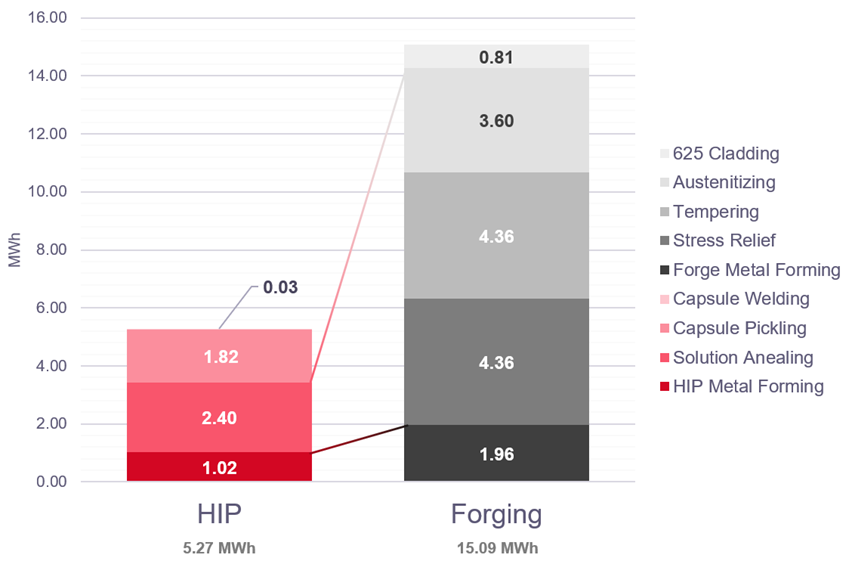
Figure 2 - Total Energy use in PM-HIP and hot forging calculations showing individual process energy use.
Our study concluded that based on the part used for comparison, and considering the variables and assumptions detailed in our calculation, we have shown that the total energy used in producing mid-sized metallic components via PM-HIP is lower than the total energy used to produce a comparable components via hot forging, with PM-HIP resulting in a 65% reduction in total energy use compared to hot forging.
The key contributing factors to the reduction were the 60% weight reduction in the optimized PM-HIP design, as well as consolidation of post-process heat treatment, with reduced machining and no overlay welding, which also has benefits in terms of risk and lead time reduction.
To further our understanding, we recommend additional studies to determine energy use in machining processes, consider the impact of batch production, review additional reference examples, and expand the analysis to include the full carbon intensity of the processes, which would likely be of further benefit to PM-HIP as the major production facilities are based in Sweden, where a high percentage of electricity generation comes from clean sources and would also produce lower emissions during transportation due to the reduced weight of the finished component.
This study highlights the potential of PM-HIP to contribute to more sustainable manufacturing practices, particularly in sectors like nuclear new build and new oil & gas processing facility construction where energy efficiency is the supply chain is paramount, and demonstrates that it is possible to have focus on environmental factors while being effective in terms of reducing cost and lead-time, with enhanced quality.
Bodycote’s PM-HIP Powdermet™ technology combines freedom in design and superior material properties resulting in optimized designs that transform primitive forged shapes into a near net shape solution. As shown in the image below applying the full strength of PM-HIP Powdermet™ technology makes it possible to re-shape a traditional heavy rectangular valve block into a sleeker, lighter, more practical design.

A traditional heavy valve block design is transformed with Bodycote's PM-HIP Powdermet™ Technology
As well offering material with superior quality delivered by PM-HIP technology, our customers are directly benefiting from leaner manufacturing processes, transforming a cladded carbon-steel product with complex logistics involving multiple suppliers into a mono-block full duplex solution supplied in finished condition by Bodycote with minimal machining. The lean process enables our customers to produce lighter products, with superior homogenous material properties, whilst reducing cost and lead-time.
For details of how Bodycote’s PM-HIP Powdermet™ technology can deliver sustainable value for your critical applications contact us using the form below.
